
Most classical psychedelics demand a steep cognitive tax: profound visual distortions almost always come paired with heavy cognitive disorientation, emotional turbulence, temporary memory impairment, and mental fog. 2C-B (4-bromo-2,5-dimethoxyphenethylamine) occupies a unique space in psychopharmacology because it decouples visual and tactile alteration from cognitive confusion, allowing users to experience intense geometric hallucinations with a crisp, fully operational mindset.
This guide breaks down the neurobiology of 2C-B’s lucid headspace, its non-linear steep dosing dynamics, safety and harm reduction protocols, regional Canadian laws, and direct comparisons with other popular compounds.
Neurochemistry: Visual Geometry Meets Executive Control
Synthesized in 1974 by Alexander Shulgin, 2C-B is a synthetic phenethylamine chemically related to mescaline, making it distinctly different for those looking to buy LSD online in Canada or explore other lysergamides. When comparing psychedelic administration and receptor dynamics, users interested in rapid-acting tryptamines often look into how to vaporize DMT, whereas 2C-B offers a much gentler, controllable ramp-up.
Its unique psychological profile stems directly from its receptor binding affinity:
- 5-HT2A Partial Agonism: 2C-B binds primarily as a partial agonist to serotonin 5-HT2A receptors located in the visual cortex, generating vivid visual geometry, color enhancement, and texture shifting.
- Preserved Default Mode Network (DMN): Classical psychedelics disrupt the brain’s Default Mode Network, leading to ego dissolution and cognitive dissolution. 2C-B leaves core executive networks largely intact at low to moderate doses, allowing users to retain linear problem-solving and conversational ability.
- Serotonin-Dopamine Balance: It acts as a weak serotonin reuptake inhibitor and low-affinity dopamine receptor agonist, offering mild tactile warmth and physical energy without triggering an overwhelming monoamine drain.
Critical Safety Note: Pure 2C-B is an isolated chemical compound. It should never be confused with “Tusi” (Pink Cocaine), which is an uncontrolled street mixture typically containing ketamine, MDMA, caffeine, and pink dye rather than actual 2C-B.
Deep Comparative Analysis: 2C-B vs. LSD vs. MDMA vs. Psilocybin
To understand where 2C-B fits into the spectrum of psychoactive compounds, it is helpful to compare its functional characteristics across sensory, cognitive, and somatic dimensions:
| Compound | Primary Category | Visual Intensity | Cognitive Fog / Confusion | Typical Duration |
| 2C-B | Phenethylamine / Psychedelic | High (Crisp, Geometric) | Low (Lucid & Functional) | 4 – 6 Hours |
| LSD | Lysergamide / Psychedelic | High (Fluid, Morphing) | High (Ego Shift / Introspective) | 8 – 12 Hours |
| Psilocybin | Tryptamine / Psychedelic | Moderate – High (Organic) | High (Emotional / Heavy) | 4 – 6 Hours |
| MDMA | Substituted Amphetamine | Low (Tracer / Light) | Low (Empathogenic / Euphoric) | 3 – 5 Hours |
The Somatic & Sensory Experience Profile
The 2C-B experience is frequently described as occupying a middle ground between the somatic warmth of MDMA and the visual immersion of LSD, without the intense emotional vulnerability of the former or the cognitive confusion of the latter:
- Tactile & Body Load: Mild to moderate physical tingling, enhanced sensitivity to touch, temperature shifts, and pleasant muscle sensation at low doses. At higher doses, body load can manifest as mild muscle tension or stomach tightness.
- Visual Distortion: Vibrant color saturation, glowing halos around light sources, visual tracers, motion blur, and sharp geometric patterns on flat surfaces.
- Auditory Enhancement: Music sounds layered and spatial, with heightened acoustic clarity rather than emotional distortion.
The Micro-Milligram Math: Steep Dose-Response Dynamics
The defining operational challenge when working with 2C-B is its non-linear dose-response curve. Unlike substances where doubling a dose yields double the intensity, 2C-B scales exponentially—meaning a tiny variance of 2–3 mg drastically alters the depth of the experience.
| Oral Dose Range | Milligrams (mg) | Subjective Sensory & Cognitive Profile |
| Threshold | 2 – 5 mg | Subtle physical warmth, heightened tactile awareness, zero visual distortion. |
| Light | 5 – 12 mg | Mild physical euphoria, enhanced musical appreciation, subtle color saturation. |
| Moderate | 12 – 22 mg | Crisp geometric visual patterns, vivid tracer effects, clear baseline headspace. |
| Strong | 22 – 30+ mg | Dense visual shifts, kaleidoscope layering, heavy physical load, mild mental push. |
Pharmacokinetics & Ingestion Timeline
- Onset: 45 – 90 minutes when taken orally (can be noticeably delayed if ingested with or shortly after a full meal).
- Peak Phase: 2 – 3 hours of steady visual geometry and tactile heightening.
- Offset / Afterglow: 2 – 4 hours of smooth descent back to baseline, typically free of significant mental burnout or emotional drain.
2C-B Legal Status in Canada (CDSA Framework)
Navigating the legal reality surrounding 2C-B in Canada requires reviewing federal scheduling laws. While adults frequently search online options to buy 2cb canada products, understanding the regulatory framework is essential:
- Schedule III Controlled Substance: Under the federal Controlled Drugs and Substances Act (CDSA), 2C-B is explicitly categorized as a Schedule III substance.
- Statutory Rules: Commercial sale, unauthorized possession, and production without direct Health Canada licensing carry statutory penalties under federal jurisdiction.
- Regional & Provincial Context: While public health initiatives in certain municipalities focus harm-reduction efforts on synthetic opioids, federal drug policy regarding Schedule III phenethylamines remains consistent across all Canadian provinces, mirroring the broader framework governing the LSD legal status in Canada.
Harm Reduction & Safety Protocols
To minimize adverse physical reactions and safeguard well-being, strict harm reduction principles must be observed:
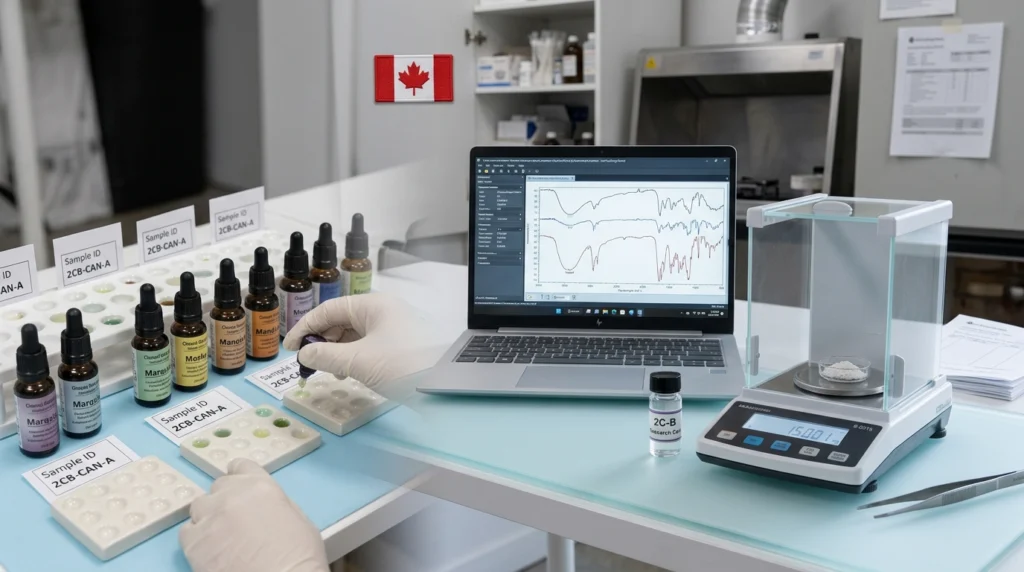
- Reagent Testing: Always test unverified samples using chemical reagent kits (Marquis, Mecke, or Froehde). Marquis reagent turns light-to-dark green in the presence of 2C phenethylamines. Advanced analytical options like mail-in FTIR spectrometry services (such as Vancouver-based GetYourDrugsTested) offer quantitative verification.
- Precision Scales Only: Visual estimation (“eyeballing”) is extremely dangerous due to the steep dose curve. Always use a precision 0.001g (milligram) scale.
- Contraindicated Stacks: Avoid combining 2C-B with MAOIs, SSRIs, or strong central nervous system stimulants (e.g., amphetamines or cocaine), as this significantly increases risk of cardiovascular strain and serotonin toxicity.
- Hydration & Thermoregulation: Phenethylamines cause mild vasoconstriction and elevated resting heart rates. Maintain hydration and stay in a comfortable, climate-controlled setting.
Frequently Asked Questions (FAQs)
Q1: Can 2C-B cause a bad trip if the headspace is lucid?
Yes. While cognitive confusion is low, sensory overload or uncomfortable bodily sensations at high doses (25 mg+) can still induce anxiety. Proper set, setting, and cautious dosing are essential.
Q2: How does 2C-B tolerance work compared to LSD?
2C-B tolerance builds more slowly than LSD or psilocybin tolerance. However, acute tolerance still develops with frequent use, and redosing late in a session yields diminishing visual returns with increased physical load.
Q3: Can low-dose 2C-B replace traditional microdosing?
Some explore sub–visual doses (2–4 mg) for tactile focus, but structured microdosing LSD protocols or psilocybin remain the primary standard for cognitive microdosing.
Q4: What is the main difference between oral and nasal administration of 2C-B?
Nasal administration (insufflation) reduces the required dose by roughly 50% and dramatically accelerates onset (5–10 minutes), but causes extreme nasal discomfort and an uncomfortably rapid rise in intensity. Oral ingestion remains the standard for controlled, gradual experiences.